The Congo Ebola Outbreak: Why This One Is Different
The Congo is facing a major Ebola outbreak caused by Bundibugyo ebolavirus, a different Ebola species from the virus behind previous major epidemics. Discover why existing vaccines may not protect against it, how Ebola actually causes death, and what Indian doctors should know.
Most Indian doctors will never see a case of Ebola. That is not a reason to ignore what is happening in the Democratic Republic of the Congo right now.
This outbreak is the largest Ebola epidemic ever recorded in the DRC and the fastest-growing on record anywhere. It is also being driven by a virus for which none of the vaccines and treatments developed over the last decade actually work. That second fact is the story, and it is one worth understanding properly — because it says something uncomfortable about how the world decides which diseases are worth preparing for.
Where things stand
The outbreak was confirmed on 15 May 2026 in the Mongbwalu health zone of Ituri Province, north-eastern DRC. It is the country's seventeenth Ebola outbreak, beginning barely five months after the last one ended, and retrospective analysis suggests the earliest infections may date to January or February 2026.
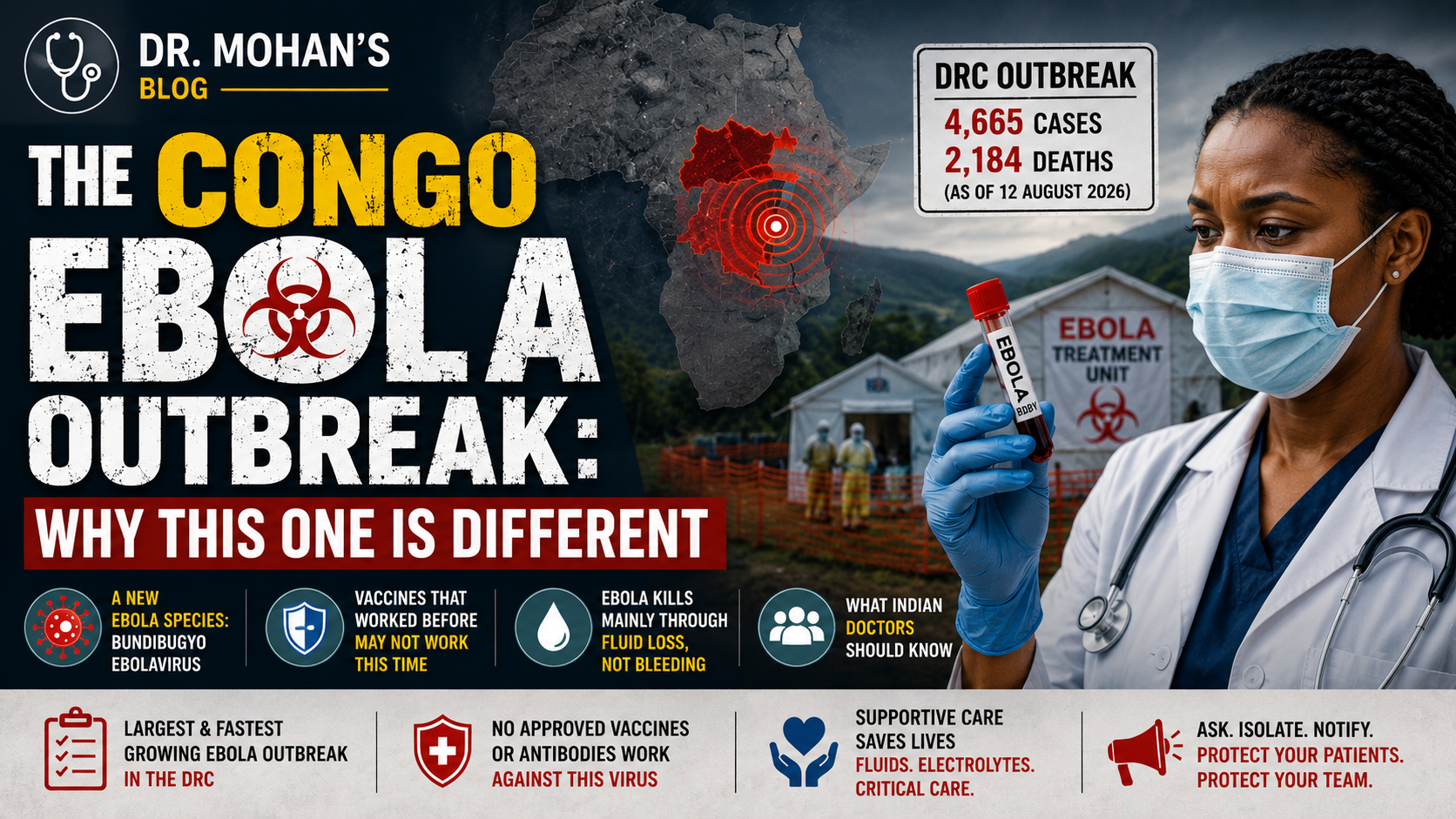
As of 12 August 2026, WHO reports 4,665 confirmed cases and 2,184 deaths in the DRC — a crude case fatality ratio of about 46.8%. From an initial single health zone, the outbreak has spread to 54 health zones across six provinces: Ituri, North Kivu, South Kivu, Haut-Uélé, Tshopo and, most recently, Bas-Uélé.
Related developments worth noting:
- Uganda declared its outbreak over on 28 July 2026, after 42 days without a locally transmitted case. It recorded 20 confirmed cases and 2 deaths, of which 15 were imported from the DRC.
- France reported a single imported case in June 2026 — a physician returning from Ituri who self-reported symptoms at Charles de Gaulle airport and was isolated immediately. That is exactly how the system is supposed to work.
- A US humanitarian worker tested positive in July and was medically evacuated to Germany.
- The outbreak has been declared a Public Health Emergency of International Concern.
Contact tracing coverage stands at roughly 84% of identified contacts in affected provinces — respectable on paper, but reports indicate a large proportion of new cases are still arising from chains of transmission that were never identified.
The species problem
Here is the part that most coverage skips, and the part that actually matters clinically.
"Ebola" is not one virus. It is a genus with several species, and the current outbreak is caused by Bundibugyo ebolavirus (BDBV) — not the Zaire ebolavirus that caused the 2013–2016 West African epidemic and most previous DRC outbreaks.
That distinction is not academic:
- Ervebo, the only currently licensed Ebola vaccine, was engineered around the Zaire glycoprotein. So was the Zabdeno/Mvabea two-dose regimen.
- The approved monoclonal antibody therapies — Inmazeb and Ebanga — are likewise licensed for Zaire ebolavirus only.
- At the nucleotide level, the Bundibugyo genome differs from Zaire by roughly 30%, with substantial divergence in the surface glycoprotein that these products target. Antibodies raised against one do not reliably bind the other.
In May 2026, after reviewing the available evidence, WHO recommended against deploying Ervebo in this outbreak outside controlled research settings, judging the data on cross-protection insufficient. The reasoning is sound and worth appreciating: partial, unproven protection is arguably more dangerous than none, because it generates false confidence in vaccinated health workers and contacts.
So the response has been running on the tools of 1976: case identification, isolation, contact tracing, safe burials, infection control, and supportive care.
Genomic work published this year adds a further complication — the circulating virus represents a distinct new clade rather than a re-emergence of a previously characterised strain, carrying over 200 nucleotide differences from the reference genome. Countermeasures in development may need tailoring to it.
Why no one built a vaccine for this
Before this year, Bundibugyo virus had caused exactly two recognised outbreaks: 131 cases in Uganda in 2007–08, and 38 cases in Isiro, DRC, in 2012.
That is the whole reason. There was never a market. Product development for filoviruses followed the epidemic that killed enough people in enough places to command attention, and Bundibugyo was not it. Globally, fewer than fifty genome sequences of this virus existed before the current outbreak.
This is what neglected disease economics looks like in practice — not an absence of scientific capability, but an absence of commercial reason to apply it. Indian readers will recognise the pattern from snakebite antivenom, from kala-azar, from rheumatic heart disease. The science was never the barrier.
What is being tried now
Three first-in-kind studies are underway, all repurposing existing products:
- PARTNERS — a platform adaptive randomised trial evaluating the pan-ebolavirus monoclonal antibody MBP134 and the antiviral remdesivir, alone and in combination. First patient enrolled 2 July 2026. It is the first randomised controlled trial ever conducted for Bundibugyo virus disease.
- EBO-PEP BUNDI — evaluating obeldesivir, an oral antiviral, as post-exposure prophylaxis for contacts. An oral agent has obvious operational advantages in this setting, though it depends on contact tracing that is itself under strain.
- A Bundibugyo-specific vaccine candidate from Oxford entered Phase I in late July 2026. WHO's expert group has identified a single-dose rVSV Bundibugyo candidate as the most promising, with development likely to require seven to nine months before trial readiness.
None of these will change the trajectory of the current epidemic. They matter for the next one.
The clinical picture, correctly understood
Ebola is still commonly taught as a "viral haemorrhagic fever," and that name has done real harm — because most patients do not bleed, and clinicians waiting for haemorrhage to consider the diagnosis will miss cases.
The typical course, after an incubation period of 2 to 21 days:
- Early phase: abrupt fever, profound weakness, severe myalgia, headache, sore throat. Clinically indistinguishable from malaria, typhoid or influenza — which is precisely the problem in endemic settings.
- Gastrointestinal phase (days 3–10): high-volume vomiting and watery diarrhoea, often several litres a day. This is the defining feature of the illness and the main driver of death.
- Later: hypovolaemic shock, acute kidney injury, electrolyte derangement — hypokalaemia, hypocalcaemia, hyponatraemia — encephalopathy, multi-organ failure. Haemorrhage occurs in a minority.
The clinically important consequence is this: most Ebola deaths are deaths from fluid and electrolyte loss, not from bleeding. Where aggressive intravenous rehydration, electrolyte correction and critical care have been delivered — as in evacuated patients treated in high-income centres — case fatality has been dramatically lower than the 40–50% seen in field conditions.
The case fatality ratio of an Ebola outbreak is, to a large extent, a measure of the health system rather than of the virus. In eastern DRC, that system is contending with armed conflict, population displacement, attacks on health facilities, strikes by unpaid health workers and infections among staff. The 46.8% figure reflects all of it.
What this means for a doctor in India
The risk to India remains very low, and there is no reason for alarm. But three practical points apply to anyone working in a casualty or medical OPD:
1. Take a travel history in febrile illness. Actually take it. The single question that identifies imported viral haemorrhagic fever is travel within 21 days. It takes five seconds and it is the only thing standing between a routine fever case and a nosocomial cluster. The French case was contained because the patient — himself a doctor — knew to declare it.
2. Know the sequence if the answer is yes. Isolate immediately with standard, contact and droplet precautions. Do not send routine samples through the general laboratory. Notify the District Surveillance Officer under IDSP without delay, and escalate to NCDC through the state surveillance unit. Confirmation and management are handled at designated facilities — the treating unit's job is recognition, isolation and notification, not diagnosis.
3. Remember the far more likely diagnoses. A returning traveller from sub-Saharan Africa with fever has falciparum malaria until proven otherwise, and malaria kills faster than the diagnostic anxiety about Ebola. Dengue, typhoid, leptospirosis, rickettsial infection and acute HIV all sit ahead of viral haemorrhagic fever in probability. Isolate, then work up the common things properly.
The bottom line
- This is the largest and fastest-spreading Ebola outbreak the DRC has ever recorded, with close to 4,700 confirmed cases and over 2,100 deaths as of mid-August 2026.
- It is caused by Bundibugyo ebolavirus, against which the licensed Ebola vaccines and monoclonal antibodies do not work — and WHO has advised against using them outside research settings.
- The absence of countermeasures reflects two decades of commercial neglect of a virus that had only ever caused small outbreaks.
- Ebola kills mainly through massive gastrointestinal fluid loss, not haemorrhage. Supportive care is the single largest determinant of survival.
- For clinicians in India: ask about travel, isolate early, notify promptly — and do not let a rare diagnosis distract you from a common and rapidly fatal one.
© Dr. Mohan Gayen | www.drmohangayen.com
Medical Disclaimer
This content is intended for educational and informational purposes only. It is not a substitute for professional medical advice, diagnosis, or treatment. Clinical decisions should be made by a qualified healthcare professional after appropriate evaluation of the individual patient. The information provided may not apply to every clinical situation and should be interpreted in the context of current guidelines and clinical judgment.
© 2026 Dr. Mohan Gayenwww.drmohangayen.com
Copyright 2026 Dr. Mohan Gayen. Official website: www.drmohangayen.com.
Comments