H1N1 Is Back in the Headlines: What the Delhi Surge Actually Means
H1N1 cases are rising sharply in Delhi this monsoon, but this is seasonal influenza—not a return of the 2009 pandemic. Learn who is at higher risk, how to recognise warning signs, and when early antiviral treatment matters.
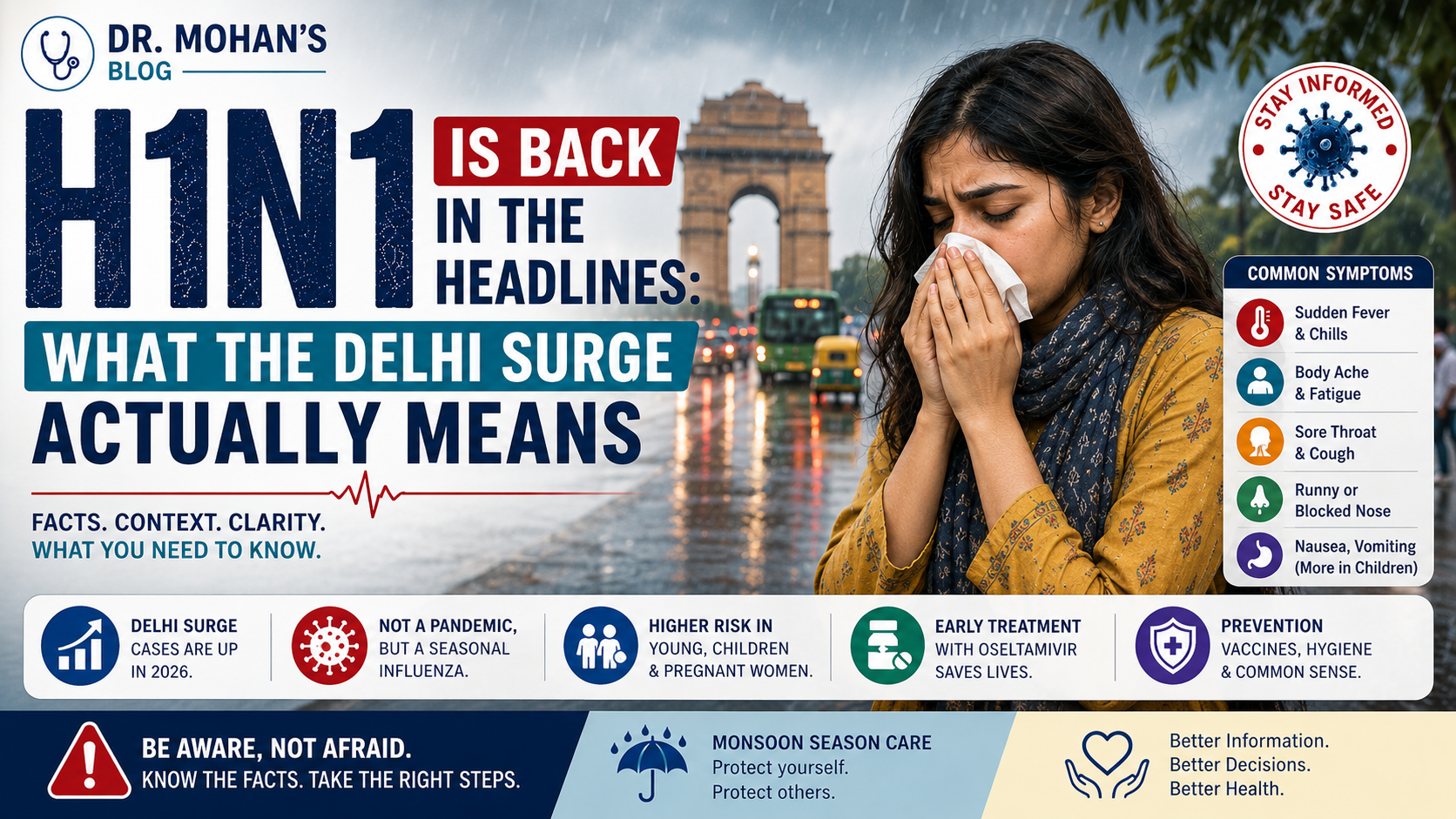
Delhi is reporting a sharp rise in influenza A (H1N1) infections this monsoon, and the word "swine flu" has returned to the front pages. Predictably, so has the panic.
Both reactions — the alarm and the dismissal — miss the point. H1N1 in 2026 is neither a returning pandemic nor a trivial cold. It is a seasonal influenza strain behaving exactly as seasonal influenza behaves in India during the monsoon, in a health system that has largely stopped thinking about influenza at all. This article covers what the numbers show, how to approach a febrile patient during this period, and where the real clinical risk lies.
What the numbers say
Delhi has recorded roughly 1,344 to 1,449 confirmed H1N1 cases so far in 2026, against about 229 cases in the corresponding period last year — close to a six-fold increase. The Delhi Health Minister has stated that no deaths have been officially recorded and that hospitals have adequate capacity, with dedicated wards and isolation rooms in government facilities. A small number of media reports have described deaths that authorities have disputed; until official confirmation, these should be treated as unverified.
Two points of interpretation matter more than the headline figure.
First, confirmed cases are not infections. These are laboratory-confirmed results in a city where testing is concentrated in hospitals and private laboratories. The overwhelming majority of influenza in the community is never tested. A six-fold rise in confirmed cases reflects some combination of genuinely increased transmission and increased testing — and the relative contribution of each is not knowable from case counts alone.
Second, case fatality rates quoted for H1N1 in India are badly misleading. Analysis of IDSP data from 2010 to 2017 found 114,667 reported cases and 8,543 deaths, giving an apparent case fatality of about 7.5%. No one should read that as the risk to an individual with influenza. It is a denominator artefact: only patients sick enough to be tested enter the numerator's denominator, so the sickest fraction of infections is being divided by itself. True infection fatality for seasonal influenza is orders of magnitude lower.
For historical scale, India recorded over 42,000 cases and close to 3,000 deaths in the 2015 season. The current Delhi figures are not in that territory.
H1N1 is no longer a pandemic virus
This is the single most common misconception I encounter, in patients and in junior colleagues.
The A(H1N1)pdm09 virus that caused the 2009 pandemic did not disappear. It became one of the seasonal influenza A strains in global circulation, alongside A(H3N2), and it has been included in seasonal influenza vaccine formulations ever since. Population immunity is now substantial. What we are seeing in Delhi is seasonal influenza activity, not a re-emergent pandemic strain.
In India, influenza has two annual peaks: the monsoon months (roughly July to November) and a smaller winter peak. Northern India is in the first of these now. A rise in influenza cases in August is expected epidemiology, not an anomaly — the question is only one of magnitude.
One genuine clinical distinction is worth remembering: unlike ordinary seasonal influenza, which falls hardest on the elderly, A(H1N1)pdm09 has consistently caused a disproportionate share of severe disease in younger adults, children and pregnant women. A previously healthy 30-year-old with influenza deserves more attention than she would with most other respiratory viruses.
The clinical picture
Typical presentation is abrupt in onset: fever with chills, marked myalgia, headache, dry cough, sore throat and rhinorrhoea, with pronounced prostration. Gastrointestinal symptoms — nausea, vomiting, diarrhoea — are more frequent in children than adults. Incubation is usually one to four days.
Clinicians in Delhi this season have described sore throat and nasal discharge as prominent features. That is a useful observation but not a diagnostic rule; symptom-based discrimination between respiratory viruses has never been reliable in individual patients.
The finding that actually separates influenza from a common cold at the bedside is the abruptness and the systemic severity — the patient who can tell you the hour their illness began, and who looks genuinely unwell rather than merely congested.
The Differential That Matters in an Indian Monsoon OPD
When a patient comes to the OPD with acute fever during the Indian monsoon, it is important not to jump to a single diagnosis. Several infections can present with fever, body ache, headache, weakness and other overlapping symptoms.
H1N1 may be in the headlines, but dengue, malaria, scrub typhus, leptospirosis, enteric fever and COVID-19 should also remain in the differential diagnosis.
Influenza A (H1N1) often presents with sudden onset of fever, prominent respiratory symptoms, marked body ache and severe fatigue or prostration.
Dengue may be suggested by retro-orbital pain, severe myalgia, rash, leucopenia, falling platelet counts and a rising haematocrit.
Malaria should be considered when there is periodic fever, splenomegaly, thrombocytopenia or a relevant travel or endemic-area exposure.
Scrub typhus deserves special attention. Look carefully for an eschar, particularly around the inguinal, axillary or perineal areas. Lymphadenopathy and deranged liver enzymes may provide additional clues.
Leptospirosis may present with conjunctival suffusion, calf tenderness, jaundice and renal dysfunction, particularly when there is a history of water exposure.
Enteric fever may be considered when fever is persistent and associated with abdominal symptoms or other compatible clinical features.
COVID-19 can now be clinically difficult to distinguish from other respiratory viral infections, so testing may be required when appropriate.
One important point to remember is that thrombocytopenia during the monsoon does not automatically mean dengue. Malaria, scrub typhus, leptospirosis and severe influenza can also cause a low platelet count. Therefore, anchoring on dengue without considering the overall clinical picture can lead to missed diagnoses.
Another important consideration is co-infection. A positive dengue test does not necessarily exclude concurrent influenza, and identifying influenza does not exclude another infection. If a patient's condition deteriorates or the clinical course does not behave as expected, the diagnosis should be reassessed.
The practical message is simple: during the monsoon, don't anchor on one diagnosis. Look at the complete clinical picture, actively search for clues, consider the important differentials and reassess the patient whenever the clinical course does not fit the initial diagnosis.
Triage and treatment
India's Ministry of Health has long used a categorisation that remains the most practical triage framework available for influenza-like illness. Clinicians should confirm the currently applicable version, but the structure is as follows:
Category A — mild fever with cough or sore throat, with or without bodyache, headache, diarrhoea or vomiting. No testing indicated. No oseltamivir. Home isolation, symptomatic treatment, and review at 24 to 48 hours.
Category B(i) — Category A features plus high-grade fever and severe sore throat. Oseltamivir indicated; testing not required.
Category B(ii) — Category A features in a high-risk individual: children under five, adults over 65, pregnancy, chronic lung, cardiac, hepatic, renal, neurological or haematological disease, diabetes, malignancy, immunosuppression, or long-term corticosteroid therapy. Oseltamivir indicated; testing not required.
Category C — any of: breathlessness, chest pain, drowsiness, hypotension, haemoptysis, cyanosis, worsening of an underlying condition, or in children irritability, refusal to feed and reduced activity. Immediate hospitalisation, testing and treatment.
The practical value of this framework is that it authorises treatment without waiting for confirmation. Oseltamivir should not be delayed for a test result.
Key treatment points:
- Adult dosing is 75 mg twice daily for five days, with dose reduction in significant renal impairment.
- Benefit is greatest when started within 48 hours of symptom onset — but antivirals should still be given to hospitalised or severely ill patients presenting later.
- Oseltamivir is recommended in pregnancy. Pregnant women are among the highest-risk groups for severe H1N1, and hesitancy about treating them causes avoidable harm.
- Confirmatory diagnosis is by RT-PCR on a nasopharyngeal or throat swab. Rapid antigen tests have poor sensitivity and a negative result does not exclude influenza.
- Antibiotics have no role in uncomplicated influenza. They are indicated only where secondary bacterial pneumonia is suspected — a deteriorating course after initial improvement, focal consolidation, or a rising procalcitonin in the appropriate context.
Prevention, and the vaccine India keeps forgetting
Annual influenza vaccination is the intervention with the best evidence, and it is dramatically underused in India outside a few institutions.
- India sits largely within the recommendation for the Southern Hemisphere formulation, ideally administered before the monsoon — April to June — though vaccination during an ongoing season still offers benefit.
- Priority groups are pregnant women, children aged six months to five years, adults over 65, those with chronic comorbidities, and healthcare workers.
- That last group deserves emphasis. Doctors, nurses and paramedical staff are both at occupational risk and a vector to vulnerable patients. Vaccination uptake among Indian healthcare workers remains poor, and it is difficult to counsel a patient credibly about a vaccine one has declined oneself.
Standard droplet precautions, hand hygiene, respiratory etiquette and staying away from work while febrile remain effective and cost nothing.
The bottom line
- The Delhi surge is real but represents seasonal influenza in its expected monsoon window, not a new pandemic threat.
- Confirmed case counts undercount infections severely, and reported case fatality rates for H1N1 in India are inflated by testing bias.
- A(H1N1)pdm09 hits younger adults and pregnant women harder than typical seasonal flu — do not be reassured by youth.
- In an Indian monsoon, the febrile patient needs a differential, not a diagnosis. Dengue, malaria, scrub typhus, leptospirosis and enteric fever share the same clinic.
- Treat on clinical grounds using the risk categories. Do not withhold oseltamivir waiting for a swab, and do not withhold it in pregnancy.
- Vaccinate the high-risk groups — and vaccinate yourself.
© Dr. Mohan Gayen | www.drmohangayen.com
Medical Disclaimer
This content is intended for educational and informational purposes only. It is not a substitute for professional medical advice, diagnosis, or treatment. Clinical decisions should be made by a qualified healthcare professional after appropriate evaluation of the individual patient. The information provided may not apply to every clinical situation and should be interpreted in the context of current guidelines and clinical judgment.
© 2026 Dr. Mohan Gayenwww.drmohangayen.com
Copyright 2026 Dr. Mohan Gayen. Official website: www.drmohangayen.com.
Comments